

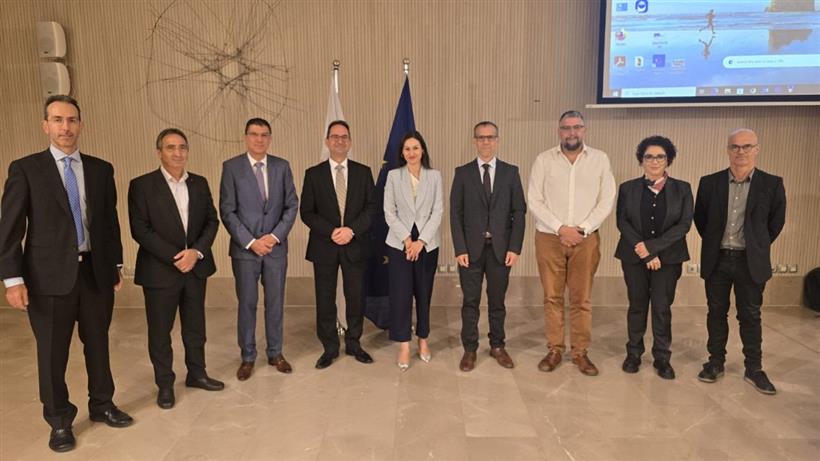
At the Presidential Palace of Nicosia, on Thursday, October 31, 2024, Cyprus placed itself at the forefront of the European green transition, highlighting that sustainable agriculture is not just an idea but a structured system of thought capable of transforming the way food is produced. The Agricultural Research Institute (ARI) and the Open University of Cyprus (OUC) co-organized a high-level conference titled “Greenhouse Gas Emissions in Agriculture and the Role of the Circular Economy in Combating Climate Change”, under the umbrella of the Recovery and Resilience Plan.
Opening the proceedings, Dr. Maria Panayiotou, Minister of Agriculture, Rural Development and Environment, emphasized the importance of creating sustainable production cycles, noting that agriculture must no longer be seen as a polluter but as an active partner in the climate solution. In their welcoming remarks, Dr. Marios Kyriakou, Acting Director of ARI, and Professor Dr. Stavros Stavrou, Rector of OUC, stressed the need for scientific evidence and education as the twin foundations of the transition toward sustainability.
At the heart of the event stood THALLA (Thriving Agroecology Living Lab) an ambitious initiative that connects knowledge, practice, and policymaking. THALLA functions as a “living laboratory” for co-creation and participatory research, where universities, research institutes, producers, and policymakers collaborate to design climate-resilient, biodiverse, and food-secure agricultural systems.
Through its focus on circular models, THALLA seeks to turn agroecological theory into a practical framework for agricultural transformation. Field studies and collaborative projects have demonstrated that Zero Waste strategies, when combined with regenerative farming practices, can significantly reduce greenhouse gas emissions while improving soil productivity and long-term sustainability.
The conference featured distinguished scientists who presented data on livestock and potato-related emissions, along with the results of the LIFE-ClimaMED and ECONUTRI projects both closely aligned with THALLA’s mission. Under the chairmanship of Dr. Michalis Omirou (ARI) and Associate Professor Dr. Antonis A. Zorpas (OUC), discussions underscored that the resilience of agricultural systems depends on close coordination between public authorities, academia, and civil society.
A symbolic highlight was the presentation of the Environmental Awards for Students in Environmental Studies, an initiative of the Ministry of Agriculture, Rural Development and Environment, recognizing young researchers for their contribution to sustainability and environmental innovation.
With the scientific coordination of Professor P. Trivellas, Director of the ORIMAS Laboratory, and the support of partner institutions across Greece and Cyprus, THALLA aims to become a European hub for agroecological innovation, producing not only research outcomes but also policy frameworks and actionable solutions. Its participatory science approach redefines how knowledge is generated — not in isolation, but through collective experimentation and co-design.
As the sessions concluded, one message resonated clearly: the agriculture of tomorrow will not be judged merely by its yields but by its capacity to breathe in harmony with the environment. In Cyprus, THALLA is already building the foundations of that balance — grounded in knowledge, collaboration, and the living fabric of the land itself.
Ακολουθήστε το Agrocapital.gr στο Google News και μάθετε πρώτοι τις ειδήσεις